I’m Martin Meir, I’m the man behind REAP Bikes and I owe you an explanation regarding the delivery of the REAP offering. Let me begin…
We have never wanted to settle for anything less than perfection, and that has slowed down the production of our bike.
We have never wanted to settle for anything less than perfection, and that has slowed down the production of our bike.
When we launched our TT bike back in 2017, we had also started development of our road bike with a few working prototypes being put through their paces. As we expected, we had a lot of initial interest from the triathlon community as a whole: both professional athletes and early adopters came forward very early on to work with us and assist in developing our Generation 1.0 frameset into a bike that was flawless in all aspects of ‘the ride’.
As an engineering-lead company, we wanted to make sure the bike worked in all aspects; speed, agility, aerodynamics and functionality. We’ll be honest, there were a few niggles that needed further development. Having never produced a bike before, the Generation 1.0 promised a lot, but we needed time to perfect and advance our initial concept. As REAP is a self-funded operation like many start-ups in the UK, we needed time to raise some further funds to finalise designs for the road bike, resolve these small niggles on our TT bike, and make the next step.
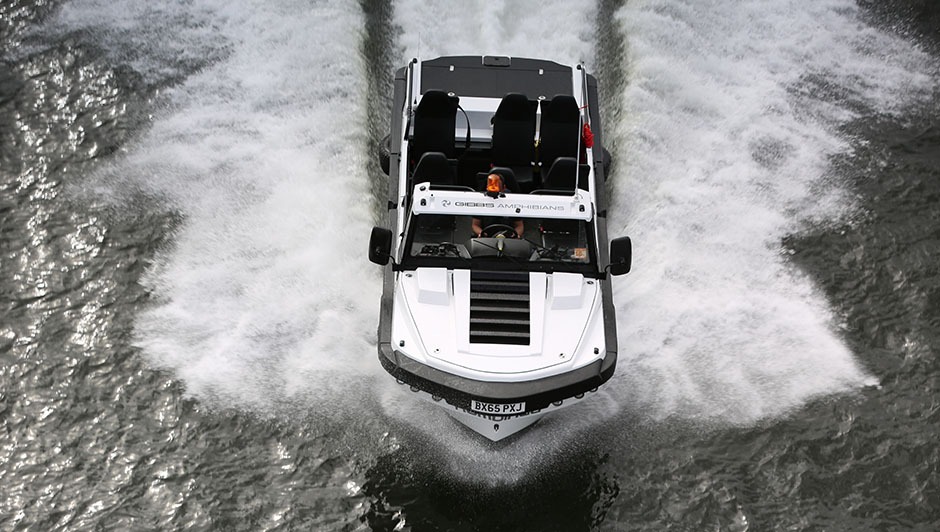
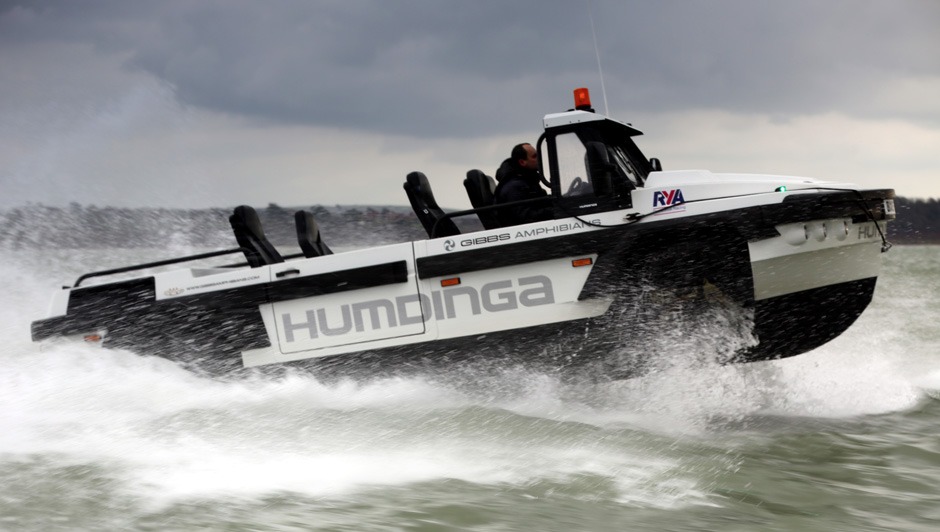
We were reliant on generating funds from the manufacturing side of our business, Kamm Projects, which has been working on the monumental task of developing an amphibious vehicle for a UK-based technologies outfit (pictured below). Fortunately, the program was successful in that it has enabled us to now move forward with the activities required for developing REAP.
Through 2019 we made sure to support our athletes as well as adding a few high-profile athletes to our roster. Tom Bishop quietly and valiantly, rode our road bike under the radar, for the full WTS season. It proved to be robust and race ready surviving a few crashes where his fellow competitors’ bikes did not. We have also been fortunate to begin a working relationship with Georgia Taylor-Brown this year.
We had targeted Spring 2020 to make both our Vulcan (TT/Tri bike) and Vekta (road bike) available to purchase for the new season, plans of which have both been curtailed due to recent circumstances. We have followed the “lockdown” guidelines and had to furlough the majority of our staff until last week.
The driving force behind REAP has always been myself and my two sons who I share a household with meaning we could continue working together and developing whilst following the government’s guidelines to keep the dream moving forward. Like you all, we have our fingers crossed for some great racing this year, with athletes competing at all levels, all around the world.
So, apologies. It has taken us longer than we planned to get this off the ground. Please forgive us for being passionate about producing the best bike we can produce for you and it needed a little more time and funding to do so than originally thought. Our passion has never wavered, in fact it is probably stronger now than on day one. We are more resolute now from having invested literal blood, sweat and tears into the project and with a belief that manufacturing our own product, here in the UK will enable us to grow to achieve our mission.
Thank you, and if you have any question for me directly, please do not hesitate to email me (martin@reapbikes.com). I’m happy to chat about anything bikes or sport at any time.
Share this post
Share on facebook
Share on twitter
Share on linkedin
Share on pinterest
Share on print
Share on email
We use cookies on our website to give you the most relevant experience by remembering your preferences and repeat visits. By clicking “Accept All”, you consent to the use of ALL the cookies. You can check our Privacy Policy page for more information.
This website uses cookies to improve your experience while you navigate through the website. Out of these, the cookies that are categorized as necessary are stored on your browser as they are essential for the working of basic functionalities of the website. We also use third-party cookies that help us analyze and understand how you use this website. These cookies will be stored in your browser only with your consent. You also have the option to opt-out of these cookies. But opting out of some of these cookies may affect your browsing experience.
Necessary cookies are absolutely essential for the website to function properly. These cookies ensure basic functionalities and security features of the website, anonymously.
Cookie
Duration
Description
cookielawinfo-checkbox-analytics
11 months
This cookie is set by GDPR Cookie Consent plugin. The cookie is used to store the user consent for the cookies in the category "Analytics".
cookielawinfo-checkbox-functional
11 months
The cookie is set by GDPR cookie consent to record the user consent for the cookies in the category "Functional".
cookielawinfo-checkbox-necessary
11 months
This cookie is set by GDPR Cookie Consent plugin. The cookies is used to store the user consent for the cookies in the category "Necessary".
cookielawinfo-checkbox-others
11 months
This cookie is set by GDPR Cookie Consent plugin. The cookie is used to store the user consent for the cookies in the category "Other.
cookielawinfo-checkbox-performance
11 months
This cookie is set by GDPR Cookie Consent plugin. The cookie is used to store the user consent for the cookies in the category "Performance".
viewed_cookie_policy
11 months
The cookie is set by the GDPR Cookie Consent plugin and is used to store whether or not user has consented to the use of cookies. It does not store any personal data.
Functional cookies help to perform certain functionalities like sharing the content of the website on social media platforms, collect feedbacks, and other third-party features.
Performance cookies are used to understand and analyze the key performance indexes of the website which helps in delivering a better user experience for the visitors.
Analytical cookies are used to understand how visitors interact with the website. These cookies help provide information on metrics the number of visitors, bounce rate, traffic source, etc.
Advertisement cookies are used to provide visitors with relevant ads and marketing campaigns. These cookies track visitors across websites and collect information to provide customized ads.
Other uncategorized cookies are those that are being analyzed and have not been classified into a category as yet.
Engineered carbon:
materials & method
Because attacks and sprints place such great loads on road race bikes, we drew on the engineering of our Vulcan tri bike to make the Vekta massively stiffer than any rival. We used the technology that made a beam bike ride like a road bike to make a road bike ride better than any before. We achieved this in two ways: material selection and construction method.
Carbon fibre comes in many grades and, as with everything, the best fibres are more expensive. At REAP, all materials are selected by engineers, not accountants, and the Vekta is made with a blend that is over 80% ultra-high modulus Toray M40J unidirectional fibre. That’s a vastly higher percentage and grade than most manufacturers use in their top models.
Our raw material cost is around 50% higher yet the Vekta is very competitively priced; it’s a reinvestment that we can make because we sell direct to you and, unlike the vast majority, we don’t outsource production – we are our own factory. Expert deployment is crucial to get the best from these materials and that’s where our 25 years of composite engineering experience are invaluable. The carbon fibre lay-up is intuitive to us.
The performance of the carbon fibre lay-up is boosted significantly by our trade secret manufacturing method, a hugely effective innovation that’s unique to REAP. We can’t tell you what it is, but we promise you will feel the difference it makes.
As a true monocoque, the Vekta is made in a single piece, whereas mass-produced bikes are made in a number of pieces and then joined. Our way is more difficult, but the result is an optimised frame, free from parasitic weight – mass that is made necessary by compromised design and doesn’t add value.
Every element of the Vekta is designed for maximum performance. Sure, there are slightly lighter aero-road frames, but none that come close to the way the Vekta feels. We chose to invest a little frame weight to achieve a huge increase in stiffness which results in levels of steering precision and power transfer efficiency you’ve never even dreamed of. We know that you’ll feel it as soon as you stand on the pedals.