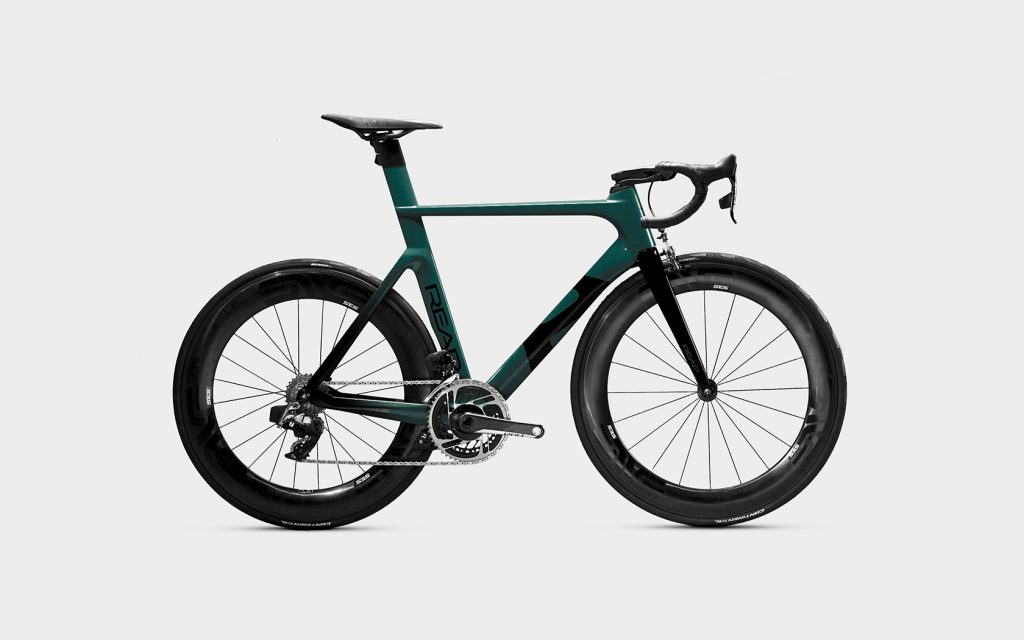
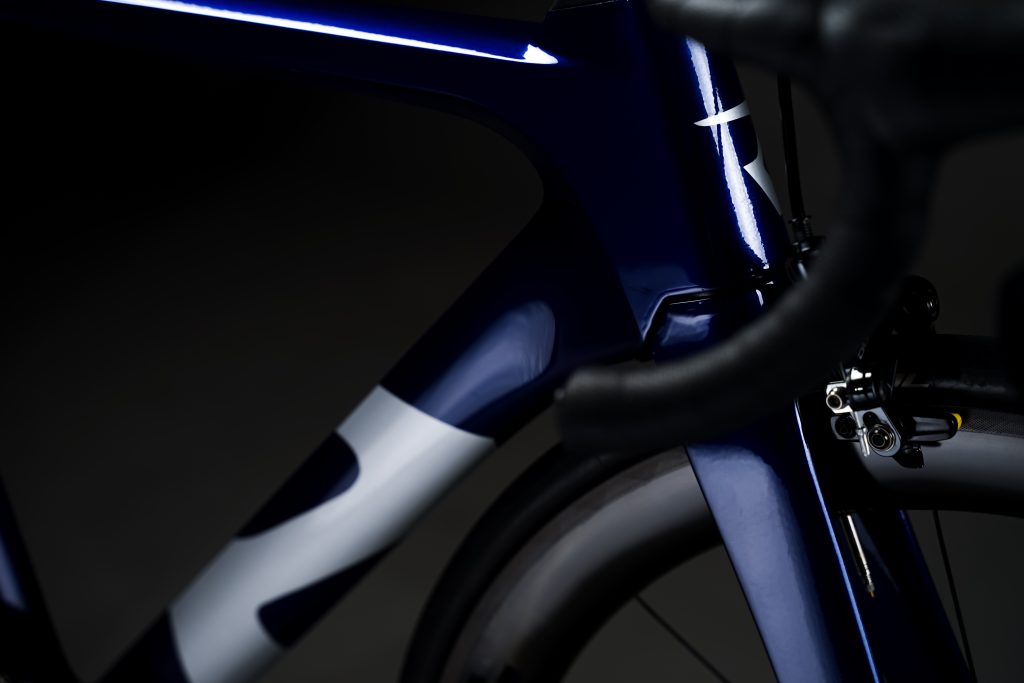
The Vekta is an incredibly aero road bike. Here we explain why it’s so fast and how our very small team made it that way.
WHY IT’S SO FAST
The Vekta is one of the very fastest aero-road bikes in the world. During development, the Vekta delivered results in both wind tunnel and velodrome testing that put it on par with top time trial bikes, never mind its own category. Reducing drag to this extent requires every element of the bike to be honed.
One of the most important ways in which the Vekta achieves its incredible speed is the precision with which we can mould the crisp edges to the frame shapes. Like many bikes, the Vekta uses truncated airfoils (think of a D shape that’s smaller at the straight edge) which make the airflow behave as if it were following a long, traditional airfoil (like a stretched out teardrop with a point). The air continues to flow smoothly once it has passed the frame and it meets again as if it had followed a complete airfoil. Turbulence, and therefore drag, is minimised.
The reasons for choosing truncated airfoils in place of complete ones are to do with how these shapes perform when part of a bike frame; they are lighter, more compliant to bump forces, and stiffer laterally against pedalling forces. They also allow designers to simulate airfoils that are beyond the UCI’s limits and as a downtube they better envelop bottles. Simply, they’re a win all round.
However, the performance of truncated airfoils (also called Kamm-tails) hinges on how sharply the shape is cut off. If the rear corners are too round, the air follows around them and becomes turbulent, and the effect is lost. A sharper radius greatly improves the aerodynamic benefit, but is very difficult to mould, generally too difficult for mass production. That’s where our specialism and composite (rather than alloy) moulds give us the edge, if you’ll forgive the pun.
The Vekta’s downtube also features a ‘trip’, a sharp crease that’s precisely placed and angled to influence the airflow to follow the virtual airfoil shape.
Several other features contribute to the Vekta’s speed:
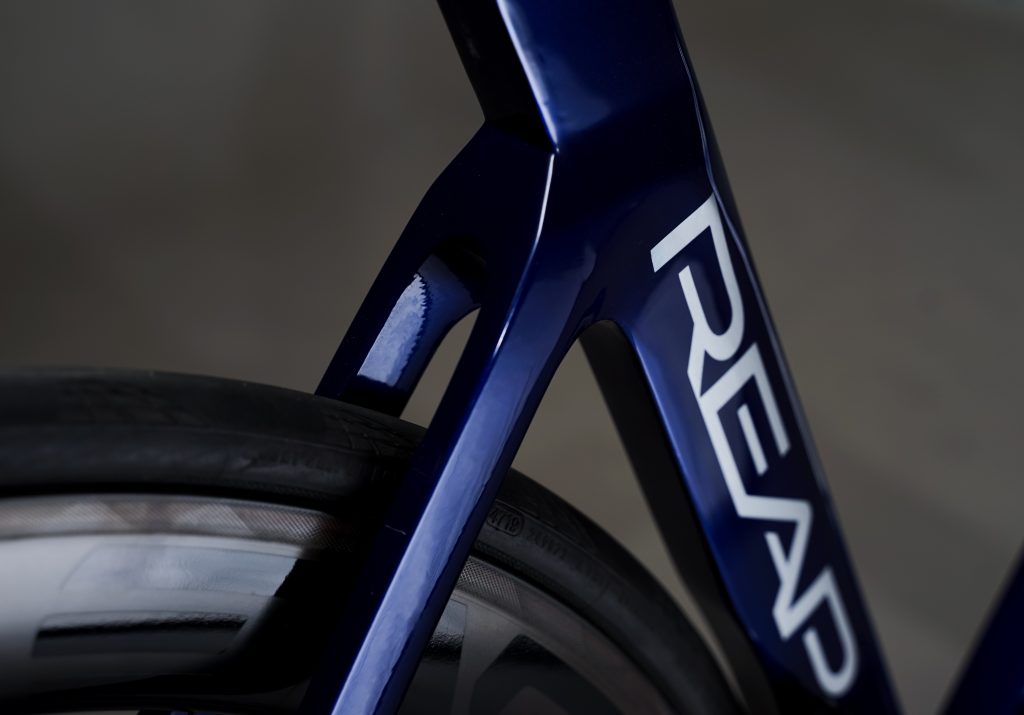
Reduced frontal area is achieved by the flat toptube and the dropped seatstays.
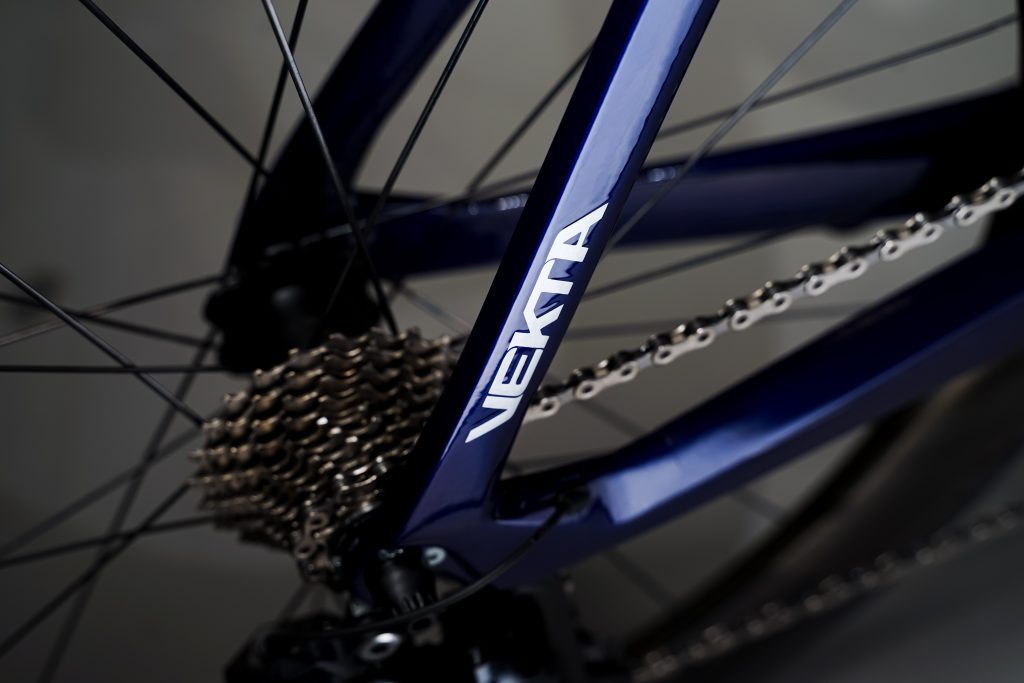
Turbulence and pressure spots are reduced by the wide stand fork and the dropped seatstays, both of which allow air moving past the bike to be less disrupted by the forward moving upper part of the wheel (spokes, rim and tyre) and the air dragged with it.
Smoother airflow is achieved by the wheel-hugging downtube and seat-tube which transition the air more cleanly between the wheels and frame.
The frame’s tube profiles have been optimised for the latest wider aero wheels with tyre widths of 25-28mm.
THE DEVELOPMENT PROCESS
The Vekta was born from REAP’s first bike, the searingly quick Gen1 tri machine. The shaping of the Gen1 was done by the same team of computational fluid dynamics (CFD) experts as designed the UK Sport bikes which dominated the London Olympics on the track and was ridden to gold in the TT by Bradley Wiggins.
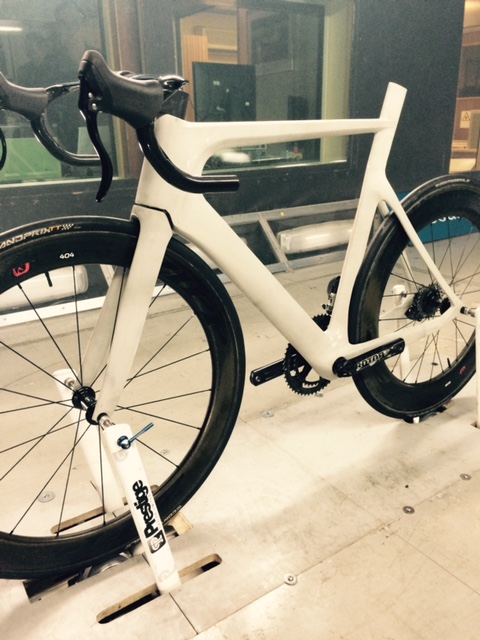
The Vekta frame was designed in CAD based on the Gen1’s profiles, then turned into a foam prototype. This model was sanded into shape by hand to adapt the structures to a double-triangle frame, scanned back into CAD, and then machined again in foam. This second rapid prototype was tested at the R J Mitchell wind tunnel at the University of Southampton and was immediately super-fast, on par with a TT/tri bike from one of the most respected aero brands.
The first rideable carbon fibre prototype was then produced and this was tested at Derby Velodrome by Dan Bigham of WattShop, with REAP pro triathlete Tom Bishop riding. Using a road helmet, bars and wheels (ENVE 7.8s), regular rather than aero brakes and a basic tri suit, the CDA figure was 0.19, a number that would be very good for a time triallist and is off the scale for a road bike. Dan was amazed at the outcome and that gave us the confidence to tool up for production.
As a very small and new brand, we didn’t have the budget to go around the R&D loop of iterate-test-revise half a dozen times, so we had to rely on expertise to get it right quickly. We were very happy when the data told us that we had.
Share this post
Share on facebook
Share on twitter
Share on linkedin
Share on pinterest
Share on print
Share on email
We use cookies on our website to give you the most relevant experience by remembering your preferences and repeat visits. By clicking “Accept All”, you consent to the use of ALL the cookies. You can check our Privacy Policy page for more information.
This website uses cookies to improve your experience while you navigate through the website. Out of these, the cookies that are categorized as necessary are stored on your browser as they are essential for the working of basic functionalities of the website. We also use third-party cookies that help us analyze and understand how you use this website. These cookies will be stored in your browser only with your consent. You also have the option to opt-out of these cookies. But opting out of some of these cookies may affect your browsing experience.
Necessary cookies are absolutely essential for the website to function properly. These cookies ensure basic functionalities and security features of the website, anonymously.
Cookie
Duration
Description
cookielawinfo-checkbox-analytics
11 months
This cookie is set by GDPR Cookie Consent plugin. The cookie is used to store the user consent for the cookies in the category "Analytics".
cookielawinfo-checkbox-functional
11 months
The cookie is set by GDPR cookie consent to record the user consent for the cookies in the category "Functional".
cookielawinfo-checkbox-necessary
11 months
This cookie is set by GDPR Cookie Consent plugin. The cookies is used to store the user consent for the cookies in the category "Necessary".
cookielawinfo-checkbox-others
11 months
This cookie is set by GDPR Cookie Consent plugin. The cookie is used to store the user consent for the cookies in the category "Other.
cookielawinfo-checkbox-performance
11 months
This cookie is set by GDPR Cookie Consent plugin. The cookie is used to store the user consent for the cookies in the category "Performance".
viewed_cookie_policy
11 months
The cookie is set by the GDPR Cookie Consent plugin and is used to store whether or not user has consented to the use of cookies. It does not store any personal data.
Functional cookies help to perform certain functionalities like sharing the content of the website on social media platforms, collect feedbacks, and other third-party features.
Performance cookies are used to understand and analyze the key performance indexes of the website which helps in delivering a better user experience for the visitors.
Analytical cookies are used to understand how visitors interact with the website. These cookies help provide information on metrics the number of visitors, bounce rate, traffic source, etc.
Advertisement cookies are used to provide visitors with relevant ads and marketing campaigns. These cookies track visitors across websites and collect information to provide customized ads.
Other uncategorized cookies are those that are being analyzed and have not been classified into a category as yet.
Engineered carbon:
materials & method
Because attacks and sprints place such great loads on road race bikes, we drew on the engineering of our Vulcan tri bike to make the Vekta massively stiffer than any rival. We used the technology that made a beam bike ride like a road bike to make a road bike ride better than any before. We achieved this in two ways: material selection and construction method.
Carbon fibre comes in many grades and, as with everything, the best fibres are more expensive. At REAP, all materials are selected by engineers, not accountants, and the Vekta is made with a blend that is over 80% ultra-high modulus Toray M40J unidirectional fibre. That’s a vastly higher percentage and grade than most manufacturers use in their top models.
Our raw material cost is around 50% higher yet the Vekta is very competitively priced; it’s a reinvestment that we can make because we sell direct to you and, unlike the vast majority, we don’t outsource production – we are our own factory. Expert deployment is crucial to get the best from these materials and that’s where our 25 years of composite engineering experience are invaluable. The carbon fibre lay-up is intuitive to us.
The performance of the carbon fibre lay-up is boosted significantly by our trade secret manufacturing method, a hugely effective innovation that’s unique to REAP. We can’t tell you what it is, but we promise you will feel the difference it makes.
As a true monocoque, the Vekta is made in a single piece, whereas mass-produced bikes are made in a number of pieces and then joined. Our way is more difficult, but the result is an optimised frame, free from parasitic weight – mass that is made necessary by compromised design and doesn’t add value.
Every element of the Vekta is designed for maximum performance. Sure, there are slightly lighter aero-road frames, but none that come close to the way the Vekta feels. We chose to invest a little frame weight to achieve a huge increase in stiffness which results in levels of steering precision and power transfer efficiency you’ve never even dreamed of. We know that you’ll feel it as soon as you stand on the pedals.